
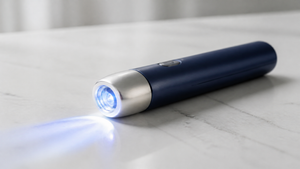

People looking for relief from varicose veins now encounter a growing range of options, from medical procedures performed in a doctor's office to handheld devices sold online. The Tidesmit Varicose Veins Laser Therapy Tool, a 415nm blue light massager, sits in that second category. It's a consumer product, and understanding what it offers—and what it doesn't—starts with a clear look at how medical laser treatments actually work.
Medical laser therapy for varicose veins has decades of clinical evidence behind it. The at-home blue light massager does not share that evidence base. That distinction matters for anyone trying to decide what a device can realistically do.
What Is the Tidesmit Varicose Veins Laser Therapy Tool?
The Tidesmit Varicose Veins Laser Therapy Tool is a handheld massager that combines physical massage with 415nm blue light. It's marketed for varicose vein concerns, but it's not a medical device. The product page describes it as a tool for at-home use, intended for comfort and light exposure without claiming to treat, reduce, or eliminate varicose veins.
Blue light at 415nm falls in the visible spectrum—you can see it. That's a very different wavelength and energy level from the infrared or near-infrared lasers used in medical vein treatments. Nobody should mistake this for a substitute for a clinical procedure. If you're considering it, the sensible step is to talk with a doctor first, especially if you have pain, swelling, or skin changes around your veins.
How Medical Laser Treatments Work for Varicose Veins
When a doctor performs laser treatment for varicose veins, they're not shining a light on the skin. For larger veins, they use a procedure called endovenous laser treatment, or EVLT. A thin catheter is inserted into the vein, and a laser fiber is threaded through it. The laser heats the vein wall from the inside, causing it to collapse and seal shut. Over time, the body absorbs the closed vein, and blood reroutes to healthier vessels.
According to Columbia Doctors, EVLT success rates range from 90% to 98%. Kaiser Permanente reports that the procedure closes the vein about 96 out of 100 times. Failure—when the vein doesn't close—happens in fewer than 4 out of 100 cases. These numbers come from clinical experience with medical-grade lasers, not consumer light devices.
For smaller surface veins, doctors sometimes use a simpler external laser. The light is applied to the skin, and sessions may last 20 to 45 minutes, repeated every few weeks. But Dr. Rema Malik notes that these veins may not disappear completely. Treatment suitability depends on vein size, overall circulation, and the presence of any advanced venous disease. Very twisted or extremely large veins may not be good candidates for laser approaches at all.
At-Home Blue Light vs. Medical Laser: What's the Difference?
The gap between a medical laser procedure and a handheld blue light massager isn't subtle—it's fundamental. One is a regulated medical treatment performed by a professional after diagnostic imaging. The other is a consumer product you buy online. Here's how they separate across three dimensions that matter.
Technology and Intensity
Medical lasers deliver targeted heat at specific wavelengths—often in the infrared range—with enough energy to thermally damage a vein wall and close it. The Columbia Doctors source describes this as a controlled injury that the body later replaces with scar tissue. The Tidesmit uses 415nm blue light, which is a visible light wavelength. Its intensity is not comparable to medical-grade lasers, and the source evidence does not address whether blue light at any intensity can affect varicose veins.
That's not a small detail. Wavelength and power density determine whether light can penetrate tissue to reach a vein, let alone change it. A surface light that's visible to the eye is doing something very different from a catheter-delivered laser that heats from within.
Tidesmit Blue Light Massager: Intended Use and Limitations
The Tidesmit device combines massage with blue light. It's handheld, cordless, and designed for at-home use. The product is not FDA-cleared for treating varicose veins, and no clinical studies are provided to demonstrate its effectiveness. The distinction between a device marketed for vein concerns and one proven to treat them is the whole story here.
If you have varicose veins and are considering this device, a doctor's input is important. Symptoms like aching, heaviness, or skin discoloration can signal underlying venous insufficiency that requires medical evaluation. An at-home massager may feel soothing, but it doesn't address the underlying vein problem.
Regulatory and Safety Considerations
Medical laser treatments are performed by trained providers and are cleared by the FDA. Their side effects—burning, pain, prickling, nerve damage, bruising—are documented in clinical sources. Kaiser Permanente lists these alongside rare but serious complications like blood clots and burns.
The safety profile of the Tidesmit is not established in the provided evidence. That doesn't mean it's unsafe, but it does mean there's no regulatory framework confirming what it can or cannot do. When a product's claims aren't backed by FDA clearance or published studies, the burden falls on the buyer to evaluate them carefully. A healthy skepticism toward unverified medical marketing is a reasonable position.
Evidence and Risks of Medical Laser Treatments
Medical laser treatments for varicose veins have a substantial evidence base, and the numbers are encouraging when the procedure is a good match. But the risks are real, and they're worth understanding before you form any comparison to at-home alternatives.
Endovenous laser treatment succeeds in closing the target vein in roughly 96 out of 100 cases, according to Kaiser Permanente. The Columbia Doctors source puts the range at 90% to 98%. When it fails, the vein stays open, and a second treatment may be discussed with the doctor.
Common side effects include burning, pain, a prickling sensation, and bruising. Nerve damage can produce tingling or pulling sensations during healing, and some people report tightness or swelling. The sources also note rare but serious complications: burns, blood clots in the vein or deep vein, and nerve irritation. These are not everyday occurrences, but they're part of the informed-consent conversation that happens in a medical setting—the kind of conversation that doesn't accompany a consumer purchase.
Practical Considerations After Medical Laser Treatment
Recovery from a medical laser procedure involves specific steps that support healing and help maintain results. These are not casual suggestions; they're part of the treatment protocol described by the sources.
After EVLT, patients are typically advised to walk for 20 to 30 minutes daily. The movement encourages circulation without straining the treated vein. Compression stockings or bandages are worn for one to two weeks to support the vein closure and reduce swelling. Strenuous activity is avoided during this period. These measures don't guarantee anything, but they're the standard aftercare that gives the treated vein the best chance to seal and heal.
It's also worth knowing that new varicose veins can appear over time. Genetics and lifestyle factors play a role, and the sources acknowledge that follow-up treatments may be needed. If a vein doesn't close, a doctor may use ultrasound to assess it and discuss whether a second treatment makes sense. None of this aftercare guidance applies to the Tidesmit device, which is a consumer product and not a medical procedure. For anyone with persistent symptoms like pain, swelling, or skin changes, a medical evaluation is the appropriate next step.
