
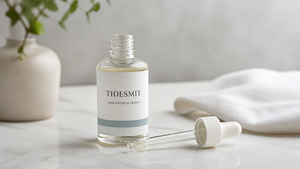

Hair growth serums often lead with numbers that feel more precise than they are. The Tidesmit Hair Growth Serum - 94% Follicle Density Treatment uses a headline percentage that should be read as a self-reported product claim, not an independently verified measurement or a promise about what any individual will see.
Separating label language from source-reported ingredient categories and usage patterns can make the category feel less overwhelming. The sections below work through that split, using published editorial roundups and routine explainers.
What a 94% Follicle Density Claim Means in Context
A 94% follicle-density figure sounds like a controlled study result, but in this context it functions as the product's headline claim. It is not an independently verified outcome, and it does not establish that any individual's hair density will change by that amount. The more useful check is whether the brand documents the ingredient list and the study design behind the figure.
Visible change from any serum is usually discussed in weeks, not days. Editorial guidance frequently mentions ranges around 6 to 12 weeks for visible growth and about 12 weeks for consistent use, though these timelines vary by formula and person. A label percentage does not compress that timeline or guarantee a result.
Before treating 94% as a benchmark, read the product's usage guidance and compare the claim against what the ingredient list actually supports. That comparison is the part you can control.
Ingredients and Comparisons the Sources Actually Cover
Editorial roundups tend to group hair-growth serums around a few repeat ingredient categories. Elle's guide to scalp serums discusses peptides, niacinamide, and castor oil as common inclusions, though none of these are attributed to Tidesmit here. The ingredient list is the only place to confirm what a specific formula contains.
Serum and oil occupy different roles in a routine. Glowusae's explainer describes serums as lightweight and quick-absorbing on the scalp, while heavier oils are positioned for mid-lengths and ends. That distinction matters more for application feel than for any outcome claim.
The older minoxidil comparison also appears in roundups as a shift, not a verdict. Sources note that natural serums have become popular alternatives, but that is a category observation, not medical advice about treating thinning.
What Daily Use Looks Like and Where Routines Go Wrong
Daily application is the most common routine in the source material, but not every formula follows the same schedule. Some serums call for twice-a-day use, and Glowusae notes that small daily habits may lead to better long-term results than occasional treatments. One product example, The Ordinary's serum, lists a full pipette as the suggested amount, which shows how specific application guidance can be.
Source-reported timelines also vary. Reduced shedding is sometimes described in a few weeks, visible growth in roughly 6 to 12 weeks, and consistent use at about 12 weeks. Those ranges are product-dependent and not a personal forecast.
Routine mistakes tend to come from impatience and buildup. Switching products every few weeks can undercut consistency before a serum has a meaningful window to work. Applying too much or letting product sit on the scalp can leave greasy roots and buildup, especially with heavier formulas. Following the applicator guidance and giving one routine enough time is often the more useful experiment than cycling through bottles.
Where the Tidesmit Serum Fits in the Hair-Serum Category
Any serum should earn a place in a routine by what its label and usage instructions actually say, not by a headline number. Category roundups can show what to look for, but they cannot reveal a formula's ingredient list. That check belongs to the product page and packaging.
Tidesmit Hair Growth Serum - 94% Follicle Density Treatment
The Tidesmit Hair Growth Serum - 94% Follicle Density Treatment presents the 94% figure as a self-reported claim, not a verified measurement. Because the full ingredient list is not provided here, the source roundups above show categories to look for rather than what this product contains.
Compare the product's stated application frequency and amount with the source-reported routines. If the label specifies a pipette amount, use that as the baseline. If it does not, that gap is worth noting before adopting the serum. The goal is criteria-based reading: label claims, ingredient transparency, and usage guidance should align.
Trade-offs and Risk Factors in Scalp Serum Use
Slow results are the most common frustration with scalp serums. Many people stop using a formula before giving it enough time. That impatience overlaps with source-reported notes that some formulas, including Ouai and Christophe Robin, may not produce as dramatic growth results as other options in the same roundup. Nulastin, by contrast, is reported to work faster than others, but that is a source-reported product comparison, not a guarantee for every user.
Physical trade-offs also show up at the scalp. Greasy roots, buildup, and flat hair with less volume can result from using too much product or choosing a heavier formula for the scalp. Tight hairstyles add another source of breakage and hair loss around the hairline, regardless of what serum is applied.
Thinning strands, shedding, and dryness are part of why people reach for a serum in the first place, but these concerns deserve a realistic timeline. Switching products every few weeks can undercut the long-term consistency that source-reported timelines depend on. The risk is not usually a single bad application; it is interrupting the routine before any change becomes visible.
Reader Questions About Hair Serum Claims and Use
What do sources say about how long hair-growth serums take to show change?
Source-reported ranges land around 6 to 12 weeks for visible growth and about 12 weeks for consistent use. Nulastin is reported to show faster change, around 3 to 6 weeks, but that is a product-specific comparison, not a universal timeline.
What do sources say about the Tidesmit 94% follicle-density claim?
The 94% figure is the product's self-reported claim and is not independently verified in the provided sources. Look for the full ingredient list and the brand's usage guidance before treating the number as a measurable expectation.
Is a scalp serum better than a hair oil for daily use?
It depends on the use case. Sources describe serums as lightweight and quick-absorbing on the scalp, while oils are heavier and better for mid-lengths and ends. Neither is better overall; match the texture to where you plan to apply it.
How can I avoid greasy roots or buildup from a scalp serum?
Follow the product's applicator and amount guidance instead of free-pouring. Source tutorials also note that switching products too often can undercut consistency, so choose one routine and track buildup over several weeks before changing course.
