
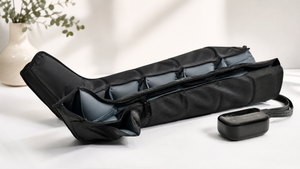

If you’re looking at the Tidesmit Air Compression Leg Massage Boots, you’re likely hoping to ease post-workout heaviness or mild leg fatigue without spending a fortune. These boots promise a simple, no-frills recovery experience with a 3-level pressure system and a full-leg airbag design. But not all recovery tools are created equal — and the Tidesmit boots sit in a crowded market where features, pressure precision, and fit vary dramatically. We dug into the available specs, compared them to pricier alternatives, and looked at what the research says about compression therapy to help you decide if they’re the right pick.
What you’ll find below is a practical breakdown of the good, the missing, and the trade-offs — not a lab test, but a clear-eyed look at how these boots fit into a real recovery routine. The Tidesmit model is radically affordable, but that low price comes with some deliberate omissions. If you’re okay with that, they might be a smart entry point. If not, we’ve lined up a few alternatives that do more.
Verdict: Who the Tidesmit Boots Are For
The Tidesmit boots are best suited for someone who wants a simple leg massage after a long day or a moderate workout, and who doesn’t need to know the precise pressure in millimeters of mercury. The three levels are straightforward — low, medium, high — and the sensation is one of gentle, sequential squeezing. For a budget-conscious buyer, that’s often enough. As Tom’s Guide notes, compression boots can be a useful recovery tool even at simpler settings, and the Tidesmit boots deliver that basic experience without the intimidating price tag of premium models.
Advanced users, however, will notice the lack of a pressure gauge or app control. The difference between each level is perceptible but not quantifiable, so you’re relying on comfort rather than data. That’s a fair trade-off for under $100, but it won’t satisfy someone who wants to dial in 60 mmHg versus 80 mmHg. The Tidesmit boots are a relaxed, low-commitment way to try compression therapy — not a precision recovery instrument.
Who Should Buy the Tidesmit Air Compression Leg Massage Boots
These boots are a sensible pick for the occasional exerciser, the person with a job that keeps them on their feet, or anyone who simply wants a no-fuss leg massage at the end of the day. The 6-airbag design provides a full-length squeeze that can feel refreshing for tired muscles, and the three levels give you a little room to adjust. Because the price hovers at the low end of the compression boot spectrum, you’re not making a huge financial bet. If you’ve never used compression boots before, the Tidesmit model is a low-risk way to see if the sensation helps you wind down or feel less stiff the next morning.
They’re less ideal for someone who does intense interval training, heavy lifting, or long-distance running multiple times a week. Those athletes often benefit from higher pressure ranges (some boots go up to 150 mmHg or more) and the ability to fine-tune sessions. The Tidesmit boots don’t disclose their pressure output, so you can’t know if you’re getting the kind of squeeze that pros rely on. Also, anyone with a medical condition like lymphedema or a history of blood clots should look for a medically cleared device, not a general wellness massager. Still, for the average person who wants a little recovery boost without the $500+ price tag, these boots fit the bill.
What the 3-Level Pressure System Actually Delivers
The Tidesmit boots don’t publish a pressure range, which is common among budget models. You get three levels, and the intensity ramps up noticeably with each click. Without a pressure gauge, you’re judging by feel — and that’s not necessarily a bad thing. A study in the Journal of Orthopedic Research and Therapy found that a single 20-minute session with compression boots reduced muscle fatigue on average, and the effect didn’t hinge on a specific pressure number. So while the Tidesmit boots won’t give you a readout, they can still deliver that pleasant, squeezed-then-released sensation that many users associate with lighter legs afterward.
In practice, the three levels are enough to find a setting that feels restorative without being uncomfortable. Level one is a gentle hug, level two adds a bit more firmness, and level three feels like a strong, deliberate squeeze. The key is to stop before pain. If you’re chasing a particular pressure threshold, you’ll be in the dark, but for a relaxing session, the simplicity works. The boots run on a corded design, so you’ll need to be near an outlet, and both sleeves must be connected to the control unit to operate — a small annoyance if you only want to use one leg.
The 6-Airbag Design and What It Means for Compression
The six airbags are arranged along the length of the boot, likely inflating in sequence from the foot upward to mimic the natural direction of venous return. That’s a step up from simpler 4-chamber boots, as more airbags can create a smoother, more graduated compression wave. However, sequential doesn’t automatically mean graduated — the pressure might be the same in each chamber, or it might taper off, but Tidesmit doesn’t specify. Premium boots like the Dr Well AF7001 use a 6-chamber system with 10 pressure levels and a more defined graduated pattern, which can feel more therapeutic. The Tidesmit’s 6-airbag layout helps avoid the balloon-like pressure of a single-chamber design, but the lack of documented chamber-by-chamber pressure control means it’s more of a uniform squeeze than a targeted massage.
For many users, the difference is subtle. The sequential inflation feels pleasant and can help with the feeling of heaviness, but if you’re expecting the kind of precision that physiotherapists talk about, you’ll notice the gap. The boots are easy to slip on and off, and the material is a lightweight nylon that breathes reasonably well for a 20-minute session. Just don’t expect medical-grade graduated compression.
Comfort and Daily Use
Fit is the make-or-break factor with any compression boot, and the Tidesmit model is no different. The boots should be snug but not so tight that they pinch before inflation even starts. Before buying, measure your calf circumference — the boots are designed for a general range, but if your calves are particularly large, you may find the fit too restrictive or the Velcro closures straining. Wirecutter’s review of massage boots highlights that a loose fit can ruin the compression effect, while an overly tight boot is just uncomfortable. The Tidesmit boots use a zipper and Velcro strap system, which helps get a secure fit, but the one-size-fits-most design has its limits.
Once you’re zipped in, a session is straightforward. Dr. Sam Botchey, a sports medicine consultant, recommends 15 to 30 minutes per session, and the Tidesmit boots are well-suited to that. The control unit is simple — two buttons, one for power and one for cycling through the levels — and the whole setup folds down small enough to stash in a closet or under a bed. The cord isn’t long, so you’ll likely be seated on the floor or a couch near an outlet. It’s a low-fuss routine: put them on, press start, and let the boots do their thing for 20 minutes. The nylon shell doesn’t trap as much heat as some thicker fabrics, so you’re less likely to end up sweaty, though it’s not exactly a cooling fabric.
Things to Keep in Mind Before You Buy
The Tidesmit boots leave out a few details that might matter to you. There’s no published pressure range, so you can’t compare them directly to models that boast 40–150 mmHg or 230 mmHg. The three levels give you a rough scale, but it’s impossible to know how much pressure you’re actually getting. Also, the boots are corded — you’ll be tethered to the control unit and a wall outlet, which is less convenient than a cordless model like some from FIT KING. If portability is a priority, this is a real limitation.
Fit is another consideration. The boots are designed for average calf sizes, and users with very large calves may find the top of the boot too tight, even before inflation. The material is forgiving but not endlessly stretchy. And while the 6-airbag design is decent, the lack of individual chamber control means you won’t be able to target just your feet or just your calves — it’s all or nothing. Finally, remember that compression boots are a recovery tool, not a cure. They can help with temporary muscle fatigue and that heavy-leg sensation, but they won’t replace sleep, hydration, or proper training. Individual results vary, and the relaxing effect you feel may be partly the simple act of sitting still for 20 minutes.
Alternatives to the Tidesmit Boots
Here are four other compression boots worth considering, each with a different strength.
Hyperice Normatec Elite
The Hyperice Normatec Elite is the top-tier pick, with precise pressure control, app integration, and a design that professional athletes swear by. It uses a 7-level dynamic air compression system and can target specific zones, making it feel more like a custom massage. The trade-off is the $1,000 price tag — a serious jump from the Tidesmit. But if you want the data, the granularity, and the build quality, this is the gold standard.
QUINEAR Leg Recovery System QN-070A
As a mid-range option, the QUINEAR QN-070A offers app-controlled pressure settings and multiple modes, giving you more granularity than the Tidesmit’s three levels. According to Fitlyfast, it’s a foot-and-calf design, so it doesn’t cover the thighs, but the customization is a step up. It’s worth a look if you want to program your sessions without spending Normatec money.
Dr Well AF7001 6-Chamber Air Compression Leg Massager
The Dr Well AF7001 uses a 6-chamber sequential compression system with 10 pressure levels and 3 massage modes, per Fitlyfast. That’s a more graduated massage than the Tidesmit, and the extra levels let you fine-tune the intensity. It’s still a corded model, but the additional chambers and settings make it feel more tailored. If you’re after a more defined compression experience, this is a solid step up.
ALLJOY Leg Massager AJFLM23
The ALLJOY AJFLM23 is a budget-friendly alternative that uses a Velcro closure system rather than a zipper. It’s in a similar price range to the Tidesmit, but the Velcro design can be a plus for those who find zippers fiddly. Fitlyfast notes it’s a basic model, so don’t expect advanced features, but it’s another low-cost entry point into compression therapy. If you’re comparing under-$100 options, the ALLJOY is worth a look alongside the Tidesmit.
