

Why Plan Choice Matters
Choosing the right mobile plan directly influences how well you can control your budget and predict monthly spending. Prepaid (pay‑as‑you‑go) options require you to top‑up in advance, giving a clear, no‑surprise bill each 30 days and avoiding credit‑check fees, which appeals to budget‑conscious users, students, or those with limited credit. Postpaid (bill‑pay) contracts bundle device financing, allowing you to spread the cost of a new smartphone over 24 months, but they lock you into a higher fixed monthly charge and often an early‑termination penalty. Irish regulators such as ComReg enforce transparent pricing, fair‑use policies and a 14‑day cooling‑off period, and new legislation (Nov 2025) lets customers cancel without penalty if a provider raises prices during a contract, and ensures you aren’t locked into an unfair deal.
Cost Structure and Billing

Prepaid (pay‑as‑you‑go) plans require an up‑front top‑up each billing cycle, meaning users pay only for the minutes, texts and data they intend to use. This eliminates surprise end‑of‑month charges and removes the need for a credit check, making prepaid ideal for budget‑conscious customers, students or those with poor credit. In contrast, postpaid (bill‑pay) plans bill a fixed amount at the end of each month, often tied to a 12‑ or 24‑month contract and accompanied by a credit check. While postpaid offers predictable monthly spending, the per‑unit cost of calls, texts and especially high‑speed data is usually lower than prepaid because the carrier spreads the expense over the contract term and can bundle device financing or unlimited allowances. Both market types include price‑increase clauses: prepaid plans may raise the top‑up amount or introduce new fees, whereas postpaid plans typically apply a scheduled annual increase (e.g., €2.50‑€3.00 in April for Vodafone and Three). These clauses can erode the initial savings of prepaid offers or increase the long‑term cost of a postpaid contract, so consumers should compare the total cost over the expected usage period rather than just the headline price.
Contract Commitment and Flexibility
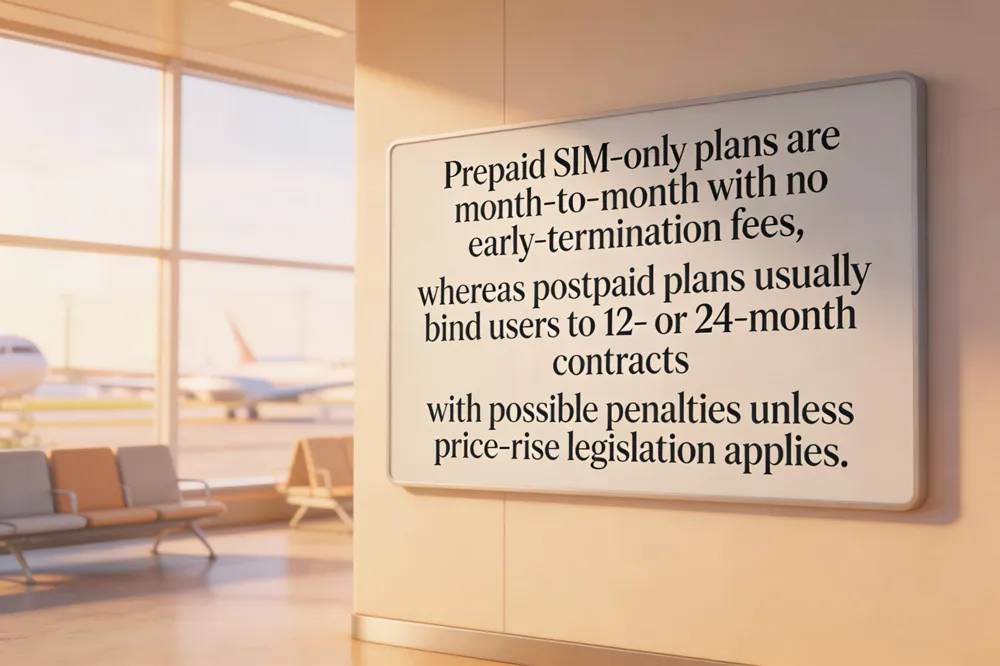
In Ireland, Prepaid SIM‑only plans are month‑to‑month with no contract are sold as rolling 30‑day contracts, meaning the service continues as long as the user tops up every month. No credit check, no long‑term commitment and no early‑termination fee apply, so customers can cancel or change plans instantly without penalty.
Postpaid (bill‑pay) SIM‑only plans usually require a Fixed‑term 12‑ or 24‑month bill‑pay contracts. These contracts lock in a monthly price and often bundle device financing, but they also impose early‑termination charges if the agreement is ended before the term expires. New Irish legislation (Nov 2025) permits customers to cancel contracts without penalty if providers raise prices during the contract term, providing a safety net for postpaid users.
Switching carriers is straightforward for both plan types. Number porting allows easy switching while keeping your mobile number lets users keep their mobile number when moving from prepaid to postpaid or vice‑versa, and there are no hidden fees for the porting process. Thus, prepaid plans deliver maximum flexibility, while postpaid plans offer predictable billing at the cost of contractual obligations.
Credit Checks and Eligibility
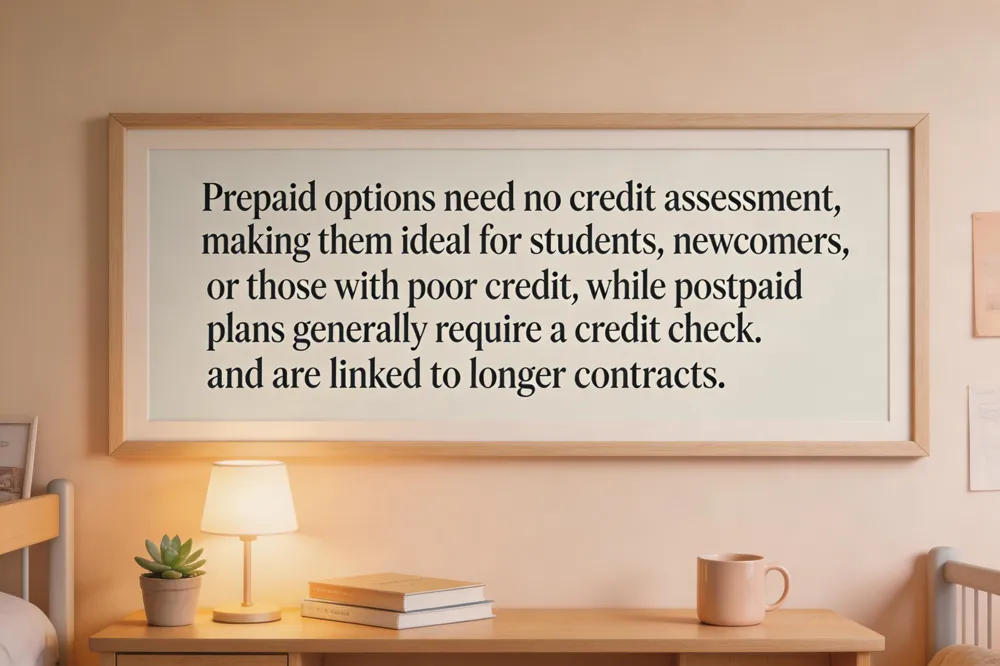
Prepaid mobile plans in Ireland are attractive because they do not require a credit check. This means users can sign up instantly, even if they have no credit history, a low credit score, or are recent arrivals to the country. The lack of a credit‑check requirement also makes prepaid plans ideal for students, short‑term visitors and anyone who prefers to keep their financial profile private. In contrast, postpaid (bill‑pay) plans almost always involve a credit assessment before the contract is approved. Providers such as Vodafone, Three, eir and Tesco Mobile use the credit check to gauge the risk of non‑payment and typically tie the plan to a 12‑ or 24‑month contract, which may include device financing. Because of this, postpaid options are less suitable for users with poor credit or those who cannot provide the necessary documentation. Consequently, prepaid plans dominate the budget‑conscious segment, offering flexible roll‑over credit, no early‑termination penalties, and the ability to switch carriers at any time without a credit‑check hurdle.
Data Allowances and Throttling
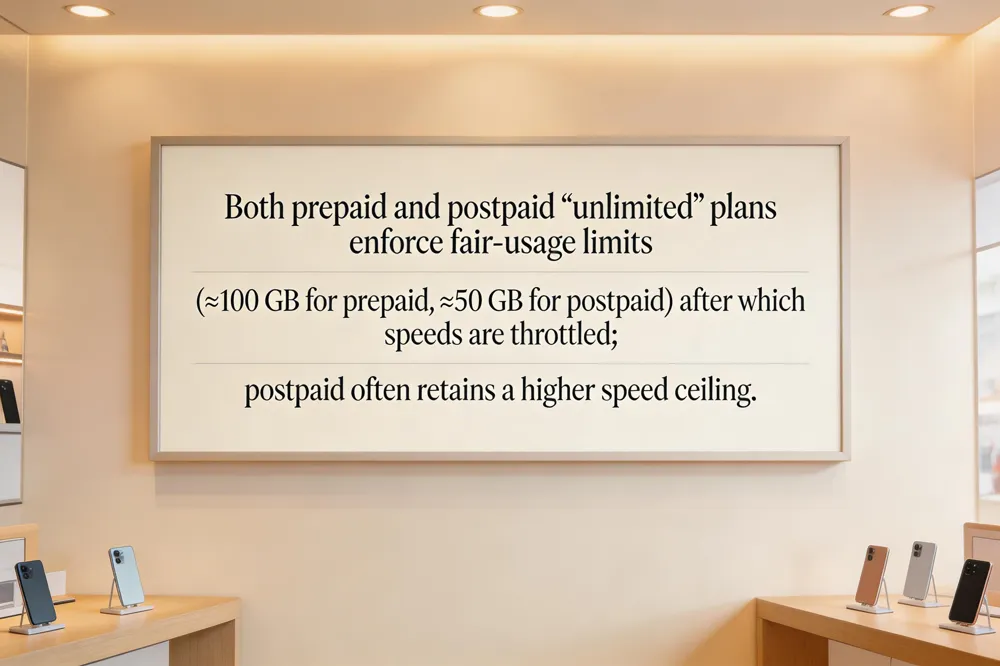
In Ireland both prepaid and postpaid plans can offer "unlimited" data, but the term is usually tempered by a fair‑usage policy. Pre‑paid SIM‑only offers such as Clear Mobile’s €12.99 plan or Lyca Mobile’s Unlimited Plus provide unlimited 5G data with a typical throttling point around 100 GB of high‑speed usage per month, after which speeds drop to a lower tier. Post‑paid unlimited plans (e.g., Vodafone Ultra SIM Only or Three Select Essentials) also employ a fair‑usage threshold, often set at 50 GB before speed reduction, but they tend to allow a higher high‑speed cap and may prioritise traffic during congestion. 5G coverage in Ireland now reaches roughly 90‑99 % of the population, with major networks (Vodafone, Three, eir) delivering gigabit‑class speeds in urban areas and solid 4G performance elsewhere. Real‑world tests reported by Switcher.ie and ComReg show that once fair‑usage limits are exceeded, both prepaid and post‑paid customers experience a noticeable slowdown, though post‑paid users usually retain a higher speed ceiling. For heavy streamers and gamers, a post‑paid contract with a higher throttling threshold may offer a smoother experience, while budget‑conscious users can mitigate occasional slow‑downs by topping up or switching to a plan with a larger fair‑usage allowance.
International Roaming and Travel

EU roaming bundles differ noticeably between prepaid and postpaid plans in Ireland. Prepaid options such as Lyca Mobile’s Unlimited Plus (€11 per 28 days) and Clear Mobile’s €12.99 SIM‑only plan include 20‑30 GB of EU roaming data, while postpaid offers like Vodafone’s Ultra SIM Only (first 6 months €25) and Three’s Bill Pay SIM‑Only plans provide 70‑80 GB of EU data and unlimited calls/texts across Europe. For travelers who want to avoid the higher roaming fees typical of postpaid contracts, buying a local prepaid SIM in the destination country or using an Irish prepaid eSIM with a travel‑specific data pack is often cheaper; many Irish providers now support instant eSIM activation, allowing users to switch to a foreign carrier without swapping a physical card. eSIM convenience also lets customers keep their home number on a physical SIM while running a prepaid eSIM for data‑only travel, simplifying number porting and eliminating the need for multiple devices. This flexibility makes prepaid plans especially attractive for short‑term trips, whereas postpaid plans suit frequent flyers who value larger EU roaming allowances and bundled perks.
Device Financing and Perks

Postpaid (bill‑pay) plans in Ireland most bundle handset subsidies, allowing customers to spread the cost of a new smartphone—such as the iPhone 17e or Samsung Galaxy S26—over a 24‑month contract. This reduces the upfront expense but ties the user to a credit check and a contractual commitment. Many carriers also add insurance and upgrade programmes; for example, Vodafone’s RED Family and Three’s Select Freedom plans include device protection and the option to swap for a newer model after 12‑18 months, often with a modest fee. Loyalty rewards are another perk of postpaid contracts: Vodafone’s Happy programme, Three’s Three+, and Sky’s Piggybank all offer points, free cinema tickets, or data roll‑overs for consistent payments. Conversely, buying an unlocked phone outright—through retailers like Tidesmit or refurbished outlets—avoids any financing interest, contract lock‑in, and early‑termination fees. While the initial out‑lay‑ can be higher (up to €500‑€600 for flagship models), the user retains full control over the SIM‑only plan, can switch providers without penalty, and benefits from the growing 5G coverage that now reaches 99 % of Ireland’s population.
Compatibility with Unlocked Smartphones

Irish carriers now support instant eSIM activation on both prepaid and postpaid SIM‑only plans, meaning users can download a carrier profile on any unlocked device without waiting for a physical card. This makes it easy to switch between providers or add a temporary plan for a trip. Dual‑SIM flexibility is especially valuable for travellers: a physical SIM can stay in the phone for a home number while an eSIM carries a local or EU‑focused prepaid plan, avoiding costly international roaming fees that are common on postpaid contracts. The unlocked‑phone marketplace, exemplified by Tidesmit, offers a wide range of 5G‑compatible devices from Apple, Samsung, Google, Xiaomi and more, all certified for Irish networks (Vodafone, Three, eir, Tesco). Because these phones are SIM‑free, they can be paired with any prepaid or postpaid carrier, letting customers choose the most cost‑effective plan for their usage pattern and switch carriers without buying a new handset. This combination of eSIM convenience, dual‑SIM travel options, and a robust unlocked catalog gives Irish consumers maximum freedom and control over their mobile experience.
Final Verdict for Unlocked Phone Users
Prepaid plans win for users who want no contract, eSIM activation and the ability to top‑up only when needed, avoiding credit checks and early‑termination fees. Postpaid plans add value for heavy data consumers, families and those seeking device financing, unlimited roaming and bundled perks. Tidesmit’s unlocked phones work with any Irish SIM, letting shoppers pair the prepaid option or a postpaid bundle with a device they already own.