
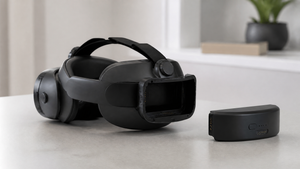

The HTC Vive Focus 3 arrived in 2021 as a standalone VR headset built for enterprise use. Priced at $1,300, it skips the consumer-friendly compromises of more mainstream headsets in favor of a spec sheet designed for training, collaboration, and all-day deployment. The Focus 3 combines a 5K-class display, Qualcomm’s Snapdragon XR2 platform, inside-out tracking, and a swappable rear battery — a combination that signals its business-first intent.
What follows is a technical reference drawn from detailed spec sheets at Univers-Simu and UploadVR, along with additional context from the VR & AR Wiki. Every resolution, refresh rate, and tracking detail below comes from those sources, so you can cross-check the numbers without hunting through press releases.
Introduction to the HTC Vive Focus 3
HTC positioned the Vive Focus 3 as a business-ready standalone that doesn’t need a PC or external sensors. According to UploadVR, the $1,300 headset launched in mid-2021 with a combined resolution of 4896 × 2448 across dual LCD panels, a 120° field of view, and the Snapdragon XR2 processor — the same chip used in the Quest 2, but run at full clock speed here. Inside-out 6DoF tracking uses four cameras, and a hot-swappable rear battery addresses the enterprise need for continuous operation without downtime.
The headset also includes a magnesium alloy frame, fixed foveated rendering, and a cooling fan. These features, along with the VIVE Business Platform and VIVE Business Streaming, push the headset away from a typical gaming device and toward a tool for simulation, remote assistance, and large-scale fleet management. The following sections break down each major subsystem in detail.
Display and Visual Specifications
The Focus 3’s visual engine starts with two LCD panels, each offering 2448 × 2448 pixels per eye, for a combined resolution of 4896 × 2448. That’s the same per-eye pixel count as the Vive Pro 2, a spec noted by both Univers-Simu and UploadVR. The horizontal field of view reaches 120°, which is wider than the 110° on the older Focus Plus and also broader than many competitors at the time of release.
Refresh rate sits at 90 Hz. While the Vive Pro 2 manages 120 Hz with the same resolution, the Focus 3 stays at 90 Hz — a trade-off that likely reflects the thermal and power constraints of a standalone, battery-powered design. Three IPD adjustment stages are available: 58mm, 63mm, and 68mm, set physically rather than through software. The headset also uses fixed foveated rendering, which reduces the shading load at the edges of the display to save GPU resources.
For enterprise users parsing text-heavy interfaces or engineering models, the high pixel density is a meaningful asset. The 120° field of view gives a wider peripheral reach than the Quest 2’s narrower optics, though the difference in refresh rate might matter more for fast-moving simulation content.
Processor and Connectivity
At the heart of the Focus 3 is the Qualcomm Snapdragon XR2. This platform represents a three-generation leap from the Snapdragon 835 used in earlier Focus models, and it’s the same silicon found in the Oculus Quest 2 — but HTC runs the chip at its full clock speed, whereas the Quest 2 is underclocked. That distinction matters most in sustained workloads, where thermal headroom and cooling design determine how long performance stays high.
The XR2 brings Wi-Fi 6/6E and Bluetooth 5.2 + BLE to the headset, as listed in the Univers-Simu spec sheet. Wi-Fi 6E, in particular, opens up the 6 GHz band for lower-latency PC streaming through VIVE Business Streaming, which can be critical for wireless desktop VR. Bluetooth 5.2 supports low-energy peripherals, though the included controllers connect via a proprietary 2.4 GHz link rather than standard Bluetooth.
There’s no official benchmark data in the sources, but the higher clock speed and active cooling via a copper heat pipe and fan suggest the Focus 3 can sustain performance that the Quest 2 may throttle back on during lengthy sessions. That’s a logical inference from the thermal design, not a guarantee of specific frame times.
Tracking and Input
The Focus 3 uses inside-out 6DoF tracking with four cameras, as detailed in the Univers-Simu spec sheet. This camera array handles spatial positioning without external base stations, which simplifies setup in an office or factory floor. The headset comes with the VIVE Focus 3 Controllers, which are shaped similarly to Oculus Quest controllers but charge via USB-C and have a non-removable battery. The spec sheet lists a 15-hour controller battery life, though the sealed battery means you can’t swap in a fresh one mid-session — a pain point for training scenarios that stretch across shifts.
Hand tracking was not available at launch. That limitation is worth noting if your deployment relies on gesture-based UI or natural interaction. The physical design of the headset itself — a magnesium alloy frame and a hybrid configuration that balances the rear battery — supports the tracking system by keeping the cameras stable and the weight distribution predictable, but the source doesn’t offer comfort claims beyond the materials used.
Four cameras provide a tracking volume that covers a wide arc in front of the user. The system is designed to handle the scale of a room, though heavy occlusion from large props or machinery could still challenge it, as with any inside-out solution.
Battery and Power Management
The most distinctive feature of the Focus 3’s power system is the hot-swappable rear battery, a 26.6Wh lithium-polymer gel pack. Swapping takes seconds and avoids the downtime that would otherwise kill a training session. Fast charging also plays a role: the spec sheet notes a 0–50% charge in 30 minutes, which gets a depleted battery back to half capacity quickly. However, for continuous all-day use, a spare battery is required — a detail that the pain point list flags directly.
Active cooling is handled by a copper heat pipe and a fan, which pull heat away from the XR2 processor and the displays. The fan is audible under load, based on the design, but the sources don’t provide decibel measurements. This thermal management is what allows the processor to run at full speed without throttling as aggressively as a passively cooled headset might.
The controller battery, by contrast, is non-removable. That creates an asymmetry: the headset can run indefinitely with a rotation of charged packs, but the controllers require a USB-C cable when they run low. For an enterprise, that means planning for charging breaks or keeping spare controllers on hand.
How the Focus 3 Compares to Other Headsets
Stacking the Focus 3 against the Oculus Quest 2 reveals the most obvious trade-offs. The Focus 3’s 2448 × 2448 per eye outpaces the Quest 2’s 1832 × 1920, and the 120° field of view is wider. Both use the XR2 processor, but the Quest 2 underclocks it, while the Focus 3 runs it at full speed. The Quest 2 costs far less, but the Focus 3’s higher resolution and active cooling make it more suitable for text-heavy enterprise applications where sharpness and sustained performance matter.
The Vive Pro 2 shares the same per-eye resolution, but it refreshes at 120 Hz and requires a PC. The Focus 3’s 90 Hz is a step down, but the standalone form factor and swappable battery give it a different kind of mobility. Against the older Vive Focus Plus, the Focus 3 bumps the field of view from 110° to 120° and jumps from the Snapdragon 835 to the XR2, a generational shift in processing power.
The controllers are frequently compared to Quest controllers in shape and layout, though the USB-C charging and 15-hour battery life are their own. The enterprise orientation is reinforced by the VIVE Business Platform and VIVE Business Streaming, which provide fleet management and PC streaming capabilities that consumer headsets lack. No source crowns the Focus 3 as the best at everything, but the spec sheet puts it in a distinct category where resolution, cooling, and swappable power take priority over price and portability alone.
