

You've seen the circular marks on an Olympic swimmer's back or a colleague's shoulders. The purple rings are hard to miss. Vacuum cupping therapy has become a go-to recovery tool for athletes and anyone dealing with persistent muscle tension. But the social-media chatter is full of conflicting claims—some call it ancient wisdom, others dismiss it as a fad. Separating what's real from what's rumor matters before you buy a set for home use.
Cupping is a complementary practice, not a medical treatment. It uses suction cups to lift the skin and underlying tissue, a technique that's been part of Traditional Chinese Medicine (TCM) for centuries. Today, plastic and silicone pump sets make it accessible without a clinic visit. The conversation around it, though, often slides into myth. Let's look at what the evidence actually says, and what you should expect from a session.
Setting the Record Straight: What Vacuum Cupping Therapy Is and Isn't
At its core, vacuum cupping therapy involves placing cups on the skin and creating suction, either with a pump or by heating the air inside. Dry cupping—the most common home method—does not break the skin. Wet cupping, which involves small incisions, is a different practice and is not designed for unsupervised use. The therapy's roots are in Traditional Chinese Medicine, but modern versions are used by massage therapists and physical therapists to address muscle tightness and temporary discomfort.
It's a complementary wellness tool, not a cure. Some enthusiasts describe cupping as a way to "remove toxins," but that's a mischaracterization. The body's liver and kidneys handle detoxification; cupping does not extract harmful substances. The deep purple and red marks are caused by broken capillaries from the suction, not by pulled-out waste. Understanding this sets more realistic expectations for what a session can do: it may help ease muscle tension and improve local circulation, but it won't solve a medical condition on its own.
Common Myths About Vacuum Cupping Therapy
A few persistent myths follow cupping around, often amplified by influencer claims. Each one oversimplifies what the therapy can accomplish or misreads the visible aftermath. Let's unpick three of the most common.
Myth: Cupping Removes Toxins from the Body
The circular marks left behind are not evidence of detoxification. In reality, the suction pulls the skin upward into the cup, which can rupture tiny blood vessels just below the surface. That's what creates the discoloration—it's essentially a bruise, not a collection of poisons. The term "toxin" is rarely used in clinical literature because it's vague; the body has a sophisticated system for filtering and excreting waste, and cupping does not bypass or supercharge it. No peer-reviewed study has shown that vacuum cupping physically removes toxins from the body, according to the Gizmo Cleaning analysis of cupping therapy myths.
Myth: Cupping Is Just a Placebo
It's tempting to write off the relief people report as a placebo effect, but the evidence is more nuanced than that. A systematic review of randomized controlled trials found that cupping reduced pain levels compared to standard care or no treatment in several studies. The mechanisms likely involve increased blood flow to the area and a release of trigger points—tight knots in muscle fibers that can refer pain elsewhere. One study on myofascial pain syndrome showed reduced trigger point sensitivity and pain after cupping sessions. While the placebo effect can contribute to any hands-on therapy, these measurable changes suggest cupping has a physiological component as well.
Myth: Cupping Always Leaves Bruises
You don't have to walk away with a polka-dot back. Static cupping, where cups sit in one spot, does tend to produce marks. But gliding techniques with silicone cups—where the cup is moved across lubricated skin—are gentler and often cause less discoloration. With practice, users can adjust suction levels to a point where marks are minimal. A therapeutic effect doesn't require heavy bruising; many people find relief with light to moderate pressure. The Dr. Body Gadget review of cupping sets notes that silicone cups give users more control over glide and pressure, reducing the likelihood of harsh marks.
What the Research Says: Evidence for Cupping Therapy
The published research on cupping is a mixed bag. While there are promising signals, the studies are often small and lack the rigorous design of pharmaceutical trials. A meta-analysis of randomized controlled trials on cupping for musculoskeletal pain reported that cupping was associated with a reduction in pain intensity compared to no treatment or usual care, but the authors cautioned that the quality of evidence was low to moderate. That means the findings are encouraging but not definitive.
One bright spot comes from research on myofascial pain syndrome. In that study, participants who received cupping showed decreased sensitivity in trigger points and reported less pain than those who did not. The likely reason: the suction creates a local increase in blood flow and may help modulate pain signals. Some researchers describe it as a form of mechanical decompression that stretches the fascia and releases muscle tension. It's a different mechanism from traditional massage, which uses compression. Still, for many conditions, the data is incomplete. If you're looking for a guaranteed fix, cupping isn't it—but for temporary relief of muscle tightness, there's a body of evidence that suggests it can help.
How to Choose a Home Cupping Set: Key Features to Consider
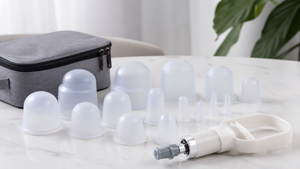
Not all cupping sets are the same, and the right one depends on your comfort level and the areas you want to target. Plastic pump sets with a hand pump give you precise control over suction and come in a range of cup diameters—35mm, 45mm, and 55mm are common sizes that fit different body parts. Silicone cups are softer, more flexible, and well-suited for gliding techniques; they're also less likely to crack if dropped. Electric smart cupping devices add features like preset modes and heating, but they require charging and can be less intuitive for beginners. Look for a set that includes multiple cup sizes, an easy-release valve to prevent discomfort, and a clear instruction manual. Safety features matter because you're creating suction on your own body.
Tidesmit 22-Piece Professional Vacuum Cupping Therapy Set
The Tidesmit 22-Piece Professional Vacuum Cupping Therapy Set is a practical starting point for home use. It includes 22 cups in a variety of sizes, so you can match the cup to the muscle group—larger cups for the back, smaller ones for the arms or calves. A hand pump gives you adjustable suction, and the included manual walks you through placement and safety. The design is straightforward: there's no battery to drain or app to learn. For a beginner, having a detailed guide alongside the hardware can reduce the guesswork. The multiple cup sizes also mean you won't need to buy a separate set as you get more comfortable with the technique.
Final Takeaway: Using Cupping Therapy Safely and Effectively
Keep sessions reasonable—10 to 30 minutes is the typical range, and leaving cups on too long increases the risk of painful blisters. Avoid placing cups directly over the spine, open wounds, inflamed skin, or major veins. If you have a blood disorder, use blood thinners, or are pregnant, check with a healthcare provider before trying cupping. The therapy is not a substitute for medical evaluation or treatment; it's a recovery tool, not a diagnostic device.
Start with light suction and pay attention to how your skin and muscles respond. The circular marks will fade in a few days, and the soreness should feel like the aftermath of a deep massage—not sharp pain. Cupping can be a useful part of a broader wellness routine, but it works best when you keep expectations grounded and technique safe.
